
Initial engagement: 5 months · React Native · AI · HL7 FHIR
Context
Engagement: 2024–2025.
Detectra's initial development was carried out for Atreon, the project's original client, in collaboration with the UNIL-CHUV Rheumatology department.
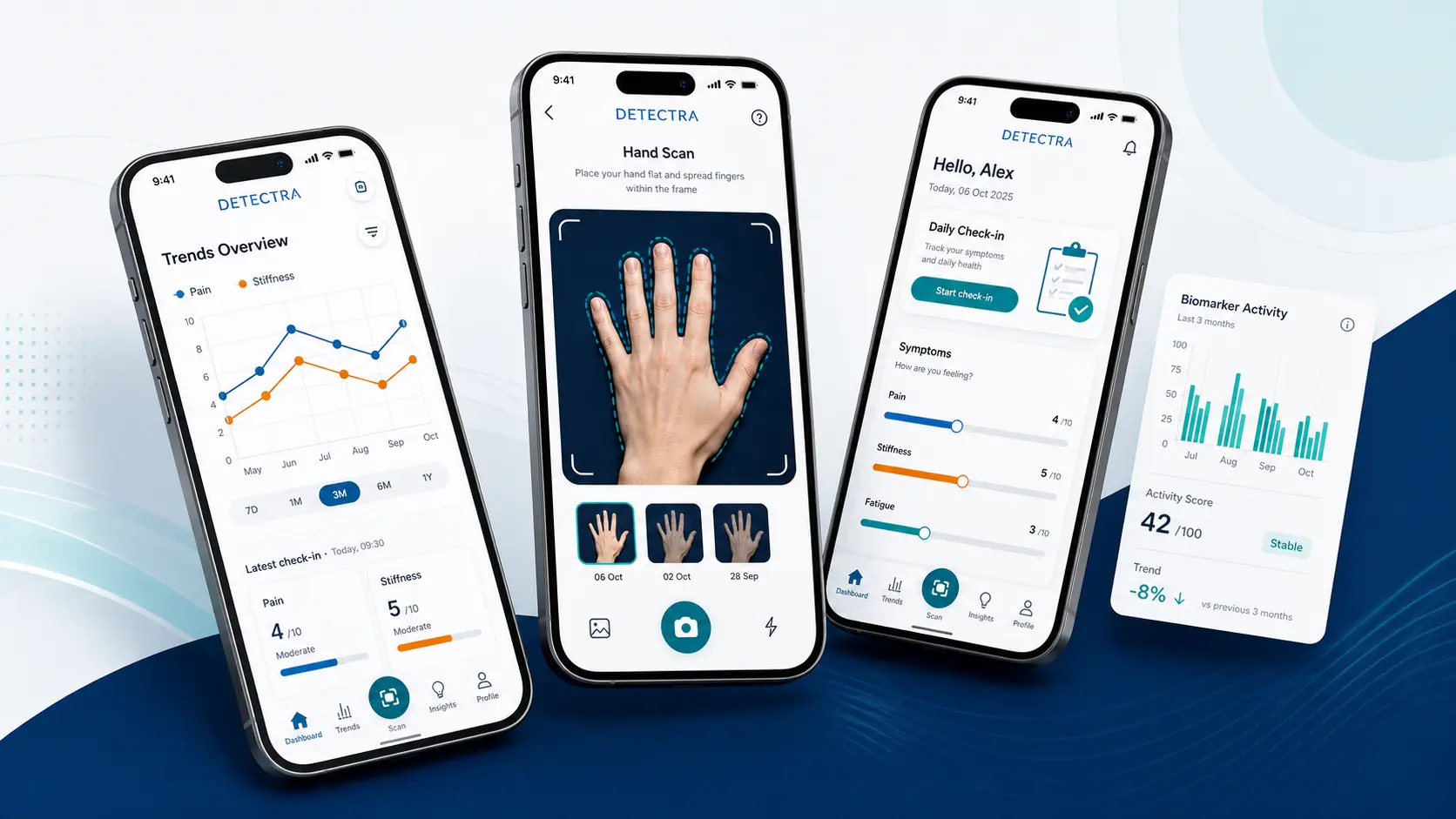
The product combines a patient app, a clinical dashboard, hand image recognition, digital biomarkers and patient-reported outcomes. Appik Studio worked on the mobile and web interfaces and their integration with the health data system.
Five months, from initial conversations to working interfaces
- Duration: 5 months within 2024–2025
- Budget: Approximately CHF 30,000 for the scope described here
- Appik team: Mathilde, Gaspard and William
- Delivery: React Native app, web dashboard, camera-based AI integration and connection to the HL7 FHIR backend
Mathilde, Gaspard and William took part in both the initial conversations and implementation. Interface and integration decisions were carried through by the people involved in development.
These figures describe this initial engagement and its scope. They are neither the total cost of the Detectra programme nor a standard price for any healthcare application.
The Detectra website identifies support from an Innosuisse Innovation Project and a CHUV PACTT InnoSTEP grant. This support applies to the Detectra project.
The challenge: designing for two different uses
For patients, the interface needed to remain easy to use for people who may have reduced finger mobility. UX/UI work therefore focused on simplicity and adapting interactions to this context.
For clinicians, doctors needed a clear web dashboard to consult follow-up information. The patient and doctor interfaces were developed in parallel, with particular attention to understandable workflows and data presentation.
What we built
- iOS and Android mobile application for patient follow-up.
- UX/UI work tailored to people with reduced fine motor control in their fingers.
- Web dashboard for doctors and clinical teams.
- Integration with a backend using FHIR for health data.
- Image-recognition workflows integrated into the follow-up process.
Project scope
| Use | Appik Studio's contribution |
|---|---|
| Use the app with reduced finger mobility | UX/UI work on simple patient journeys and interactions. |
| Consult follow-up information as a doctor | Clinical web dashboard, designed alongside the mobile app. |
| Connect interfaces to the health data system | Integration with the FHIR backend. |
| Use images in follow-up workflows | Integration of image-recognition workflows. |
Atreon was the client for the initial development. Collaboration with the UNIL-CHUV Rheumatology department provided the clinical context; Appik Studio's role described here concerns interface development and software integration.
Deliverables and approach
The engagement combined a patient app, a doctor dashboard and their integration with the health backend. Design work addressed ease of use for patients and clarity of information for clinical teams together.
This coordination of UX, interfaces and data gives each audience its own interface connected to the same follow-up system.


 Swiss Made Software